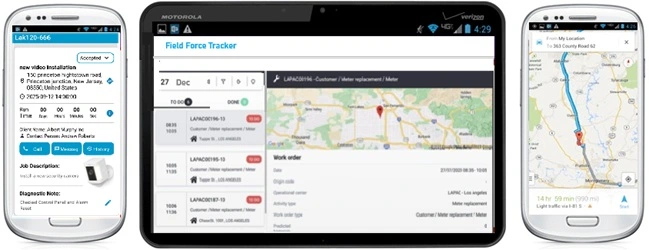
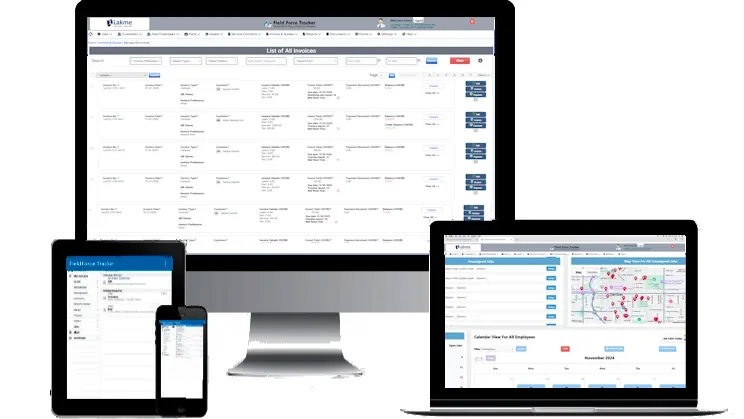
dashboard on different platforms

5 Signs Your Business Has Outgrown Spreadsheets and Needs a Field Service App
Spreadsheets are great when you’re just starting. One truck, a handful of jobs a week, and a simple sheet with customer names and addresses can carry a service business a long way. But growth changes everything.

As you add technicians, take on more customers, and juggle multiple job sites in a day, that same spreadsheet starts working against you instead of for you. Rows get overwritten. Tabs get out of date the moment someone closes the file. And nobody in the office has the full picture at the same time.

If any of this sounds familiar, your business may already be past the point where spreadsheets can keep up. Here are five clear signs it’s time to move to a proper field service app.

1. You’re Double-Booking Technicians More Than Once in a While

A spreadsheet only shows what true the last time someone updated it. If two dispatchers are booking jobs at the same time, or a technician’s schedule changes mid-morning, the sheet doesn’t catch it. Nobody finds out until a customer calls asking where their technician is.

This usually shows up as:

  • Two customers booked for the same technician at the same time.
  • A technician sent to a job that was already cancelled or rescheduled.
  • Office staff calling technicians just to confirm what job they’re actually on.

A field service app solves this by giving everyone the same live schedule. When a job is booked, moved, or cancelled, the whole team sees it instantly. No version of the schedule’s “a few minutes behind.”

2. Your Team Spends More Time Searching for Information Than Using It

In a spreadsheet-based business, customer history, job notes, and equipment details often live in different places. Maybe the invoices are in one file, service notes are in another, and warranty details are written on a paper form in a filing cabinet somewhere.

When a technician needs to know what was done on the last visit, or whether a part is still under warranty, that information should be one tap away. If your team is calling the office, digging through folders, or asking a coworker to remember details from months ago, the system has become the bottleneck.

Warning signs include:

  • Technicians calling the office mid-job to ask about service history.
  • Different versions of customer notes stored in different places.
  • New staff struggling to find basic account details on their own.

A connected field service app keeps customer records, past visits, contracts, and notes together in one account. Anyone on the team can pull up the full picture in seconds, whether they’re in the office or standing at the customer’s door.

3. You Have No Real-Time View of Where Your Technicians Are

Spreadsheets don’t move. They can’t tell you if a technician is running late, stuck in traffic, or already finished for the day. As a result, the office is often guessing, calling technicians throughout the day just to check in, which wastes time on both ends.

This becomes a bigger problem as your fleet grows. With two technicians, you can probably keep track by memory. With ten, that’s no longer realistic.

You might be feeling this if:

  • You have no way to see technician locations without calling them directly.
  • Dispatchers assign jobs based on guesswork rather than actual availability.
  • Customers are given wide, vague arrival windows because nobody knows exactly when a technician will show up.

Field service apps with live technician tracking take the guesswork out of this. The office can see who’s on the road, who’s on site, and who’s free next, all without picking up the phone.

4. Invoicing, Quotes, and Payments Are Falling Behind

When quotes and invoices are built manually in a spreadsheet, they take longer to prepare, and mistakes are easy to miss. A wrong price, a missing line item, or a delayed invoice can quietly cost a business real money every month, especially as the number of jobs increases.

Common signs your invoicing has fallen behind:

  • Invoices going out days or weeks after the job is completed.
  • Manually re-entering job details into accounting software.
  • Customers paying late simply because the invoice took too long to arrive.

A field service app can generate quotes and invoices directly from completed job details, send them to the customer right away, and even accept payment on the spot. Many also connect directly to accounting platforms, so the numbers move automatically instead of being typed in twice.

5. Growth Feels Harder Instead of Easier

This is often the clearest sign of all. In a healthy, growing service business, adding a new technician or taking on more customers should feel like progress. If it instead feels like extra stress, more confusion, and more room for mistakes, the tools behind the business haven’t kept up with the business itself.

Ask yourself honestly:

  • Does onboarding a new technician take longer than it should because there’s no standard system to train them on?
  • Do you avoid taking on more jobs because you’re not confident the schedule can handle it?
  • Are simple questions, like “how many jobs did we complete this month,” hard to answer without manually counting rows?

A spreadsheet was never built to scale with a growing team. A field service app is. It’s designed to handle more technicians, more customers, and more job complexity without falling apart the way manual systems do.

Field Force Tracker: Built for Businesses That Outgrew Spreadsheets 

Field Force Tracker has spent over 15 years working alongside service businesses, and that experience shows in how the software is built. It isn’t a generic scheduling tool with a few extra features bolted on. 

It’s a complete field service management platform, built by people who understand the day-to-day reality of running technicians, jobs, and customer relationships at the same time.

Thousands of service companies across more than 30 countries rely on Field Force Tracker to move past spreadsheets and manual tracking, including businesses in HVAC, plumbing, electrical, security and fire alarm, elevator service, and office equipment.

What a Growing Business Gets with Field Force Tracker 

Here are some key features a growing business gets with Field Force Tracker:

  • A live, shared scheduling and dispatch board, so double-booking becomes a thing of the past.
  • Real-time technician tracking, so the office always knows who’s available and where.
  • Centralized customer records, contracts, and service history in one place.
  • Quotes and invoices that can be created, sent, and paid in minutes.
  • Inventory and parts tracking across one location or several.
  • Mobile apps that contain all the features so that the technicians can access them from one place.
  • Industry-specific tools built for the way different trades actually work.

The software is also designed to grow alongside a business, whether that means adding more technicians, opening a second branch, or expanding into new service regions. Onboarding is supported with personalized training and hands-on data migration, so switching away from spreadsheets doesn’t feel overwhelming.

Conclusion

Outgrowing spreadsheets isn’t a failure. It’s a sign that your business is growing the way it should. The trouble starts when the tools you’re using can’t keep pace with that growth, leading to double-booked technicians, missing information, and invoices that go out too late.

A dedicated field service app replaces the guesswork of spreadsheets with a single, connected system that your entire team can rely on, from the office to the field.

If any of these five signs sound familiar, it may be time to see what a proper field service app can do for your business. Request a free trial or demo of Field Force Tracker and see how much simpler running your service business becomes when everyone is working from the same page.

Field Service mobile app

How Plumbing Companies Use a Field Service App to Stop Double-Booking

Double-booking is one of the most common scheduling challenges plumbing companies face, and one of the most costly. When two customers are booked into the same time slot, or the same technician is assigned to two jobs at once, the result is a disrupted schedule, a delayed customer, and an office team scrambling to recover. What appears to be a minor scheduling error often translates into a cancelled job, a dissatisfied customer, and lost repeat business.

In most cases, the underlying issue is not the dispatcher, but the system they are relying on. When scheduling is managed through a whiteboard, a shared spreadsheet, or handwritten notes, maintaining an accurate, real-time view of technician availability becomes increasingly difficult. 

As a plumbing company adds technicians and takes on more service calls, these manual methods become harder to sustain and more prone to error.

A field service app is designed to solve this problem at its source. By giving the entire team a single, real-time view of the schedule, it eliminates the guesswork that typically leads to double-booking. The sections below outline how this works in practice.

A Single, Shared Schedule for the Entire Team

When bookings live in one shared system instead of a paper calendar or a spreadsheet that only one person can edit at a time, there is no more guessing. The dispatcher can see instantly who is free, who is already on a job, and who is on the way to their next stop.

This matters more than it sounds. In a lot of small plumbing shops, the schedule exists in someone’s head, or in a notebook that only one dispatcher understands. If that person is out sick or on the phone, someone else books a job in the same slot without knowing.

A shared, live schedule removes that risk because:

  • Every dispatcher sees the exact same calendar, updated in real time.
  • Nobody has to call around to check if a slot is actually free.
  • New bookings are visible to the whole office the second they are made.

Real-Time Technician Availability

A field service app tracks each technician’s status as the day moves along. If a job runs long because a pipe repair turned into something bigger, the system reflects that right away. The office does not have to call the technician to ask if they are free, and the technician does not get handed a second job they cannot possibly make.

This status tracking usually covers:

  • Whether a technician is on the road, on site, or finished for the day.
  • How long the current job has been running compared to what was estimated.
  • Which technician becomes available next, and when?

This is one of the simplest ways a field service software for small business plumbing company avoids the classic problem of assigning two customers to the same 2 PM slot.

Job Assignments Based on Availability and Location

Booking work manually usually means picking whichever technician comes to mind first. A dispatcher might assign a job to someone who is already tied up across town, simply because they forgot to check.

A field service app removes that guesswork. It shows live location and current job status, so the dispatcher can assign the closest available technician instead of relying on memory. 

This leads to:

  • Fewer wasted trips across town for jobs someone else was closer to.
  • Fewer overlaps caused by assigning the “usual” technician out of habit.
  • Technicians who are not rushing between jobs that were never realistic to fit into one day.

Automatic Conflict Alerts

Even with a good system, mistakes can slip in, especially during a busy call volume day. A solid field service app flags it the moment two jobs are booked into the same window for the same technician, instead of letting the office find out when a customer calls asking where their plumber is.

That small warning can save a company from an awkward phone call and a lost customer.

Accurate Appointment Windows for Customers

When scheduling is disorganized, plumbing companies tend to give customers wide arrival windows just to cover themselves. A four-hour window sounds vague and frustrating from the customer’s side, and it usually means someone is sitting at home waiting longer than necessary.

With a connected system, dispatchers know exactly how a technician’s day is moving along, so they can give tighter, more realistic time windows. Customers appreciate that far more than they let on, and it cuts down on the “where is my plumber” calls that eat up office time.

Automated Tracking for Recurring Jobs and Service Agreements

Plumbing companies that offer maintenance plans or service contracts run into a different version of the double-booking problem. A recurring job gets missed, forgotten, or booked twice because nobody is tracking renewal dates by hand.

A field service app keeps recurring jobs, contract renewals, and maintenance visits scheduled automatically, so they show up on the calendar without someone having to remember to add them. That alone prevents a lot of accidental overlaps.

Centralized Customer Records for Smarter Scheduling

A field service app that also works as a small business CRM keeps customer history, past visits, and notes attached to every account. So when a customer calls back, the office already knows what was done last time, how long the job usually takes, and whether it needs a specific type of technician.

That context helps dispatchers make smarter scheduling decisions instead of booking jobs based on guesswork about how long something might take.

Why This Matters for Growing Plumbing Companies

Plumbing companies that are adding technicians, taking on more service calls, or juggling multiple crews cannot keep running on a paper schedule forever. What works for two trucks starts falling apart at five or six. Double-booking becomes more frequent, not less, as the business grows, unless the scheduling process grows with it.

This is exactly why more plumbing companies are moving toward field service software for small business operations rather than trying to manage everything through spreadsheets and phone calls. It is not about adding complexity.

It is about giving the office and the technicians one shared, accurate picture of the day so nobody gets double-booked by accident.

How Field Force Tracker Helps Plumbing Companies Solve This

Field Force Tracker is built for plumbing businesses that want a straightforward way to manage scheduling, dispatching, technician tracking, and customer records in one place. 

With Field Force Tracker, plumbing companies get:

  • A live, shared dispatch board so every job and every technician is visible in one place.
  • Real-time technician status and location, so jobs are assigned to whoever is actually free and closest.
  • Automatic conflict flags that catch double bookings before a customer ever notices.
  • Recurring job and service agreement tracking, so maintenance visits are never missed or duplicated.
  • A built-in small business CRM that keeps customer history, notes, invoices, and communication together.
  • Mobile apps for technicians, so schedule changes reach the field instantly instead of over the phone.

Together, these features give the office and the technicians one accurate picture of the day, so customers get realistic appointment windows and the team spends less time fixing avoidable mix-ups.

Conclusion

Double-booking is rarely about a careless dispatcher. It is almost always a sign that the scheduling process has outgrown the tools behind it. Whiteboards, spreadsheets, and phone calls work fine for a one-truck operation, but they start breaking down the moment a plumbing company adds more technicians and more jobs.

A dedicated field service app fixes this by giving everyone the same live schedule, flagging conflicts automatically, and keeping customer and job details organized in one system. That is exactly why more growing plumbing companies are moving toward field service software for small business operations instead of trying to hold everything together manually.

If double-booking has been a recurring headache for your plumbing company, it may be time to see how a proper field service app can fix it. Request a free trial or demo of Field Force Tracker and see how much easier scheduling becomes when your whole team is working off the same page.